
1. Introduction
Acid pickling is a crucial process in the steel industry, used to remove oxides and scale from the surface of carbon steel materials such as plates, profiles, tubes, coils, and wire rod. This treatment enhances the quality of the steel surface, ensuring better adhesion for subsequent coatings or treatments.
2. Acid Pickling Process
The pickling process involves immersing steel components in acid baths to dissolve iron
oxides. The two most used acids are:
- Hydrochloric acid (HCl) at 18% w/w concentration, usually at room temperature.
- Sulfuric acid (H2SO4) at 10-20% w/w concentration, typically used at temperatures between 50 and 80°C.
2.1 Step-by-Step Process:
- Pre-cleaning: If necessary, surface contaminants like grease or oil are removed
before pickling. - Acid Bath Immersion: Steel parts are submerged in acid baths for 5 to 60
minutes, depending on the oxidation level. - Oxide Dissolution: The acid dissolves iron oxides, forming a spent pickling
liquor (SPL) as it accumulates dissolved iron. - Rinse: The treated steel is washed to remove residual acid.
- Neutralization & Passivation: In some cases, neutralizing agents or inhibitors
are applied to prevent flash rusting. - Drying & Further Processing: The cleaned steel is dried and sent for coating,
painting, or galvanization.
2.2 Pickling systems;
Depends of kind of product the pickling process can be in continous form, typical
for coil production (Fig 1), using spray nozles and temperature the pickling time is
very short (2-5 minutes). In case of Tubes, rods, and wire coils ususlly in batch
process by inmersion in a big tanks (Fig 2 and Fig 3), ambient temperature for HCl
or warm at 50-80C and inmerion time from 10 minutes till several hours
2.2 Pickling systems;
Depends of kind of product the pickling process can be in continous form, typical
for coil production (Fig 1), using spray nozles and temperature the pickling time is
very short (2-5 minutes). In case of Tubes, rods, and wire coils ususlly in batch
process by inmersion in a big tanks (Fig 2 and Fig 3), ambient temperature for HCl
or warm at 50-80C and inmerion time from 10 minutes till several hours

Fig 1 Continuos steel coil pickling process (HCl)


Fig 2 Steel Rod pickling by inmersion /. Fig 3 Typical pickling baths for inmersion
3. Spent Pickling Liquor (SPL) and Regeneration
After use the concentration of Fe+2 increase and the concentration of free acid decrease the efectivity, needs more time for correct pickling, usually the spent pickling liquor is replaced for fresh acid, producing a harmful and expensive to dispose liquid waste (SPL)
Over time, the acid bath accumulates iron, reducing its effectiveness. The bath must be discarded or regenerated when iron concentrations exceed:
- 120 g/L for HCl pickling baths.
- 50 g/L for H2SO4 pickling baths.
3.1 Hydrochloric Acid Regeneration
3.1.1 The Ruthner process (spray roasting) Fig 4 is the most common regeneration method for spent hydrochloric acid. The process involves:
- Spray the SPL into a hot chamber.
- Thermal decomposition of FeCl2 at high temperatures.
- Recovery of HCl vapors, which are condensed and reused (HCl 18%)
- Formation of iron oxide (Fe2O3) as a by-product.

Fig 4 Ruthner process or spray roasting
However, this process is not viable when the SPL contains zinc (Zn), cadmium (Cd), or aluminum (Al), as these metals interfere with thermal decomposition.
Advantages for Spray Roaster, specialty for production plants:
-Recovery ≥98% of HCl (18%)
-Production of Hematite (Fe2O3)
-Several references worldwide
Disadvantages of Spray Roaster
-High cost of capital for investment (≥3 Mio € per 1 Ton/h of SPL)
-High OPEX, using natural gas estimated: 70-75 €/ton treated
-Compliances with flue gas emission
3.1.2 The new DIME ARS for Hydrochloric Acid SPL
The DIME ARS system Fig 5 is an innovative closed-loop technology designed to recover spent hydrochloric acid (HCl) from metal pickling processes and to simultaneously recover valuable iron salts. It is particularly relevant for surface treatment industries such as coil steel, wire and tube manufacturing, where large quantities of HCl are used and spent in the removal of scale and oxides.
Process Overview
– The system treats spent HCl pickling baths containing dissolved iron (mainly Fe²⁺).
– Based on Fe²⁺ salt precipitation, as ferrous sulphate, recovered in market uses form.
– Uses a cheap and market abundant product, sulfuric acid, as Fe²⁺precipitant
– Mean smart separation system for the mixture HCl and H2SO4 by HDH evaporation recovers HCl (volatile acid) and remains H2SO4 (non-volatile product) to reuse in precipitation.
– The recycled HCl (18%) is reused in the pickling process, reducing the need for fresh acid.
– The system is designed to eliminate any liquid waste, all recycled, ZW: Zero Waste.

Fig 5 Schematic process description for DIME ARS
Outputs
– Recovered HCl for reuse in pickling lines.
– Ferrous sulphate crystals sub-product for several industrial and agriculture applications
Benefits
– Up to 95% reduction in fresh acid consumption.
– Zero waste generation.
– Reduced footprint
– Revenue from recovered iron salts.
– Improved sustainability and compliance with circular economy principles.
Applications
– Hot &Cold Rolling Steel products pickling.
– Steel Rod and Wires pickling.
– Seamless Steel Tubes pickling.
– Any industry using hydrochloric acid for metal surface treatment.
3.1.3 Conclusion
ARS LIFE DIME is a proven, eco-innovative system that supports both economic and environmental goals by recovering critical resources from industrial effluents. It offers a practical pathway toward more sustainable surface treatment operations through acid regeneration and resource recovery.
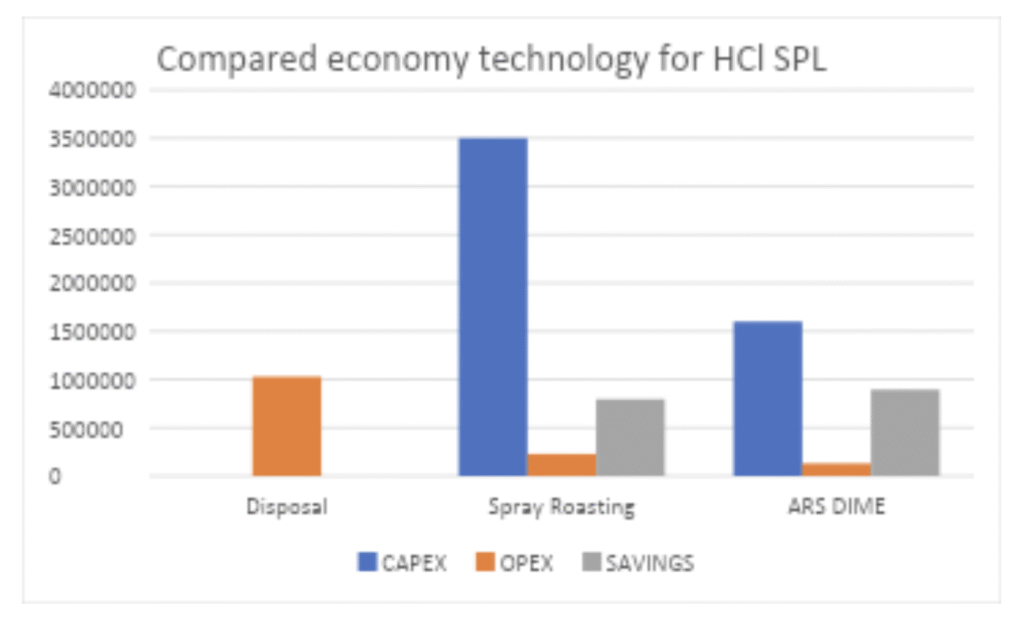
3.1.4 CAPEX, & FOOTPRINT for 24 Ton/day SPL Life DIME regeneration treatment
| Process | CAPEX € | Footprint |
| Spray Roasting | 3.500.000 | 490 m2 |
| ARS LIFE DIME | 1.600.000 | 230 m2 |
3.1.5 OPEX for 24 Ton/day SPL Regeneration Treatment (5700 Ton/year)
| Process | Spray Roasting | ARS DIME |
| Electrical Energy kW/ton | 58 | 65 |
| Electrical Energy cost €/ton (1) | 8,70 | 9.75 |
| Thermal energy NG kWt | 1150 | — |
| Thermal energy Hot water kWt | — | 600 |
| Thermal energy cost (2) €/ton | 69 | 36 |
| Reagent kg/ton | no | 0.160 |
| Reagent cost €/ton (3) | no | 22,4 |
| Spare/Replacement €/Ton | 6.8 | 3.0 |
| Process | Spray Roasting | ARS DIME |
| Disposal waste Ton/Ton | no | no |
| Subproduct to sell Ton/Ton (4) (5) | 0,156 (FeO) | 0.439 (FeSO47H2O) |
| Subproduct selling incomings €/Ton | 18,72 incomings | 48,29 (incomings) |
| Maintenance hours/y(6) | 900 | 360 |
| Cost maintenance €/Ton | 4,73 | 1.89 |
| Span life estimated years | 15 | ≥20 |
| Total OPEX €/Ton SPL | 70,51 | 22.86 |
Notes: 1: Electricity cost: 0.15 €/kW; 2: Thermal cost NG: 0,06€/kW 3: H2SO4 98% 140€/Ton H2SO4;
4: FeSO4 7 H2O selling price 120 €/ton product, 5:FeO selling price 120 €/ton; 6: 30 €/h
3.1.6 Cost comparation
4. Sulfuric Acid Regeneration
There’re several technologies to regenerate SPL for sulfuric acid and iron sulfate:
-Acid Retard (Separation method)
-Diffusion Dialysis (Separation method)
-Cooling Crystallization (Regeneration method)
4.1 Acid Retard
The heart of the Acid Retard unit (Fig 6), the resin column can adsorb Sulfuric Acid while rejecting a solution of weakly acidic to waste. The acid can readily be recovered from the resin with a simple water wash. This process only permits free acid and not acid combined with metal (Fe+2)
Normally it works by cycles with fix volume:
- Pass 1000 l pickling bath into Acid Retard column, acid is retained and flows the salts and small amount of sulfuric acid in form of waste liquid to be treated
- Empty the column by air flushing to remove the rest of the exhaust pickling bath
- Pass 1000 l clean water and recover the sulfuric acid retained, the acid is returned to pickling bath maintain the Fe+2 in bath controlled with necessity to replace


Fig 6. Acid retardation system
Example for 1000 kg cycle (15% H2SO4 free, 5% Fe+2) mass balance
Q1: 1000 kg (150 kg H2SO4; 50 kg Fe+2)
Q2: 1000 kg clean water
Q3:1000 kg (20 kg H2SO4; 48 kg Fe+2) to WWTP or disposal
Q4: 1000 kg (130 kg H2SO4; 2 kg Fe+2) to recycle in pickling bath
4.2 Difussion Dyalisis (Membrane Separation Process)
The spent acid is metered through the system in contact with one side of an anion exchange membrane (Fig 7) Water is metered counter-current to the acid flow on the recovery side of the membrane. The acid passes through the membrane into the water, leaving the heavy metal contaminants behind. The reclaimed acid is directed back to the original process while the metal laden spent acid stream flows to metal recovery or wastewater treatment. A small amount of virgin acid is added to the process tank to make up for the acid consumed in process.
Regeneration Continuous Process by DD
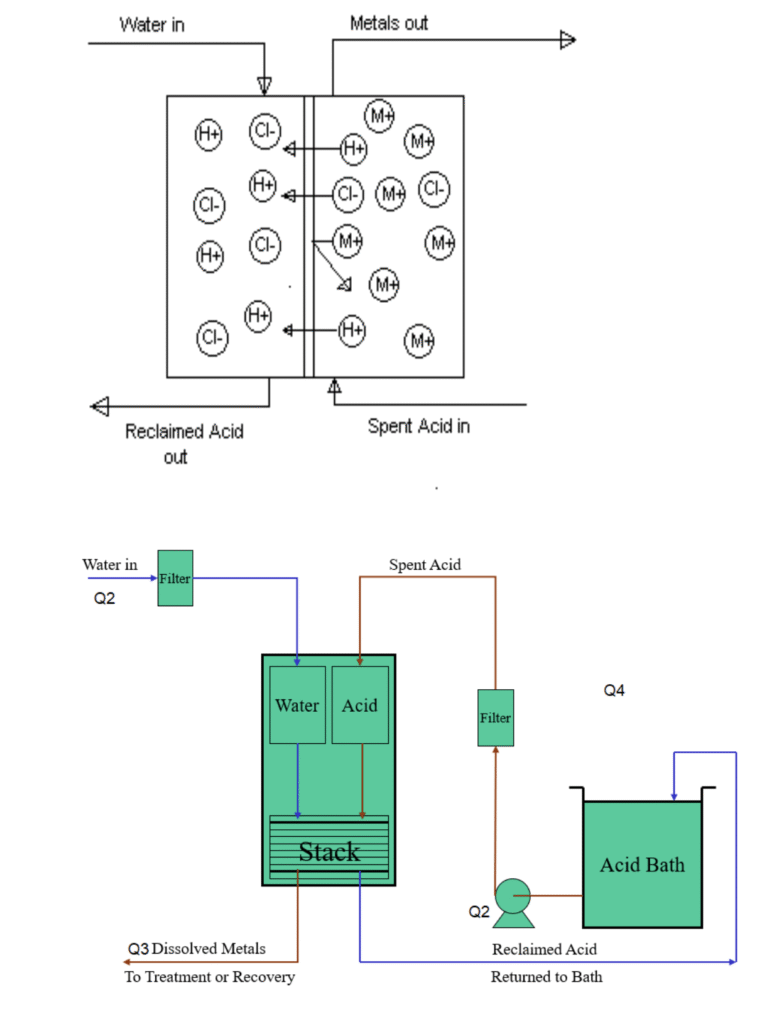
Fig 7 Difussion Dyalisis System
Example for 1000 kg continuous (15% H2SO4 free, 5% Fe+2) mass balance
Q1: 1000 kg (150 kg H2SO4; 50 kg Fe+2)
Q2: 1000 kg clean water
Q3: 1000 kg (30 kg H2SO4; 48 kg Fe+2) to WWTP or disposal
Q4: 1000 kg (120 kg H2SO4; 2 kg Fe+2) to recycle in pickling bath
4.3 Cooling Crystallization
Spent sulfuric acid (SPL) is typically regenerated using cooling crystallization (Fig 8), a long-established technique, precipitation of FeSO4 7H2O with low solubility permits resue again the pickling product (Fig 9)
- Cooling the SPL, which leads to precipitation of ferrous sulfate (FeSO4 • 7 H2O). Dosing H2SO4 to balance solution for FeSO4 crystals precipitation
- Separation of crystals from the solution and dewatering
- Recovery of the remaining acid, Reused in pickling bath.
Unlike the Ruthner process, cooling crystallization has no limitations regarding the presence of other and can operate in continuous or batch mode.
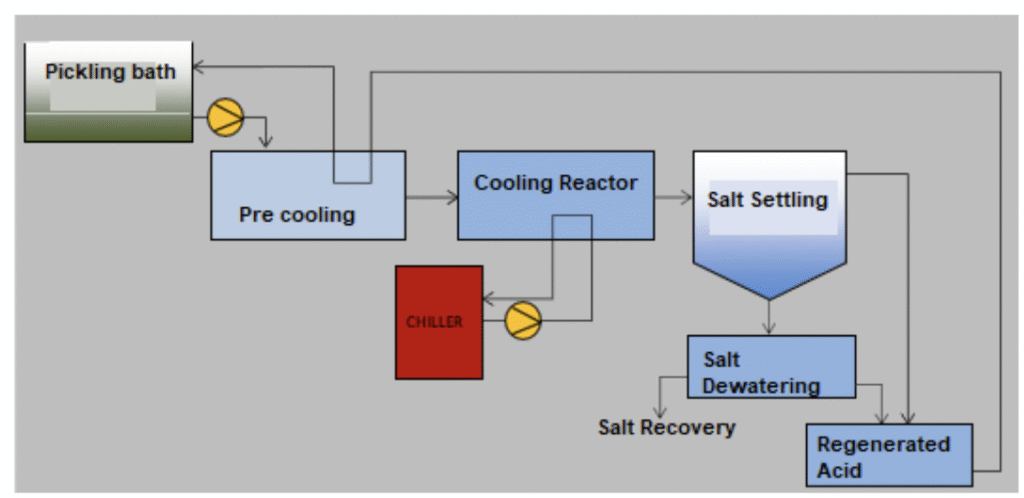
Fig 8 Process Schema for Sulfuric acid pickling Regeneration

Fig 9 Iron Solubility in Sulfuric Acid about Temperature
Example for 1000 kg continuous or discontinuous (15% H2SO4 free, 5% FeSO4) mass balance:
Q1: 1000 kg (150 kg H2SO4; 50 kg Fe+2)
Q2: 63 kg H2SO4 (98%) + 80 kg H2O
Q3: 174 kg Fe SO4 7 H2O
Q4: 969 kg (150 kg H2SO4; 15 kg Fe2SO4) to recycle in pickling bath
With this technology it is possible to regenerate and recover also the sulfuric acid combined with Fe+2 by adding fresh H2SO4. The subproduct FeSO4 7 H2O is a valuable product for several industries. The pickling bath doesn’t need replace (Fig 10)

4.4 Regeneration Technology Compared for Sulfuric SPL
CAPEX, & FOOTPRINT for 24 Ton/day SPL Regeneration treatment
| Process | CAPEX € | Footprint |
| Acid Retard | 740.000 | 90 m2 |
| Diffusion Dialysis | 1.850.000(*) | 100 m2 |
| Cooling crystallization | 950.000 | 240 m2 |
(*)DD Membrane represents 70% of CAPEX
OPEX for 24 Ton/day SPL Regeneration Treatment (5700 Ton/year)
| Process | Acid Retard | Diffusion Dialysis | Cooling Crystallization |
| Energy kW/ton | 5.0 | 7.0 | 65 |
| Energy cost €/ton (1) | 0.45 | 1.05 | 9.75 |
| Reagent kg/ton | no | no | 0.063 |
| Reagent cost €/ton (2) | no | no | 9.0 |
| Water kg/Ton | 1.0 | 1.0 | 0.080 |
| Spare/Replacement €/Ton (3) | 3.8 | 72 | 3.0 |
| Disposal waste Ton/Ton | 1.0 | 1.0 | no |
| Cost for disposal or treatment €/Ton (4) | 40 | 40 | no |
| Subproduct to sell Ton/Ton (5) | no | no | 0.174 |
| Subproduct selling incomings €/Ton | no | no | 21 (incomings) |
| Maintenance hours/y | 90 | 120 | 260 |
| Cost maintenance €/Ton | 0.7 | 0.9 | 1.85 |
| Span life estimated years | 10 | 10 | ≥20 |
| Total OPEX €/Ton SPL | 45.95 | 114.95 | 2.6 |
Notes: 1: Electricity cost: 0.15 €/kW; 2: H2SO4 98% 140€/Ton H2SO4; 3: Membrane DD 3 years or Resins 5 years
4: Disposal or WWTP in own plant estimated 40 €/Ton waste 5: FeSO4 7 H2O selling price 120 €/ton product

5. SPL Application in Hot-Dip Galvanizing Industry
One of the most significant applications of cooling crystallization is in hot-dip galvanizing plants. In these industries, the pickling bath not only contains Fe2+ but also Zn2+, accumulated from the steel racks.

Process in Galvanizing Plants:
- Steel Pickling: Steel is pickled in sulfuric or hydrocloric acid baths, accumulating Fe2+ and Zn2+ in the SPL.
- Rinsing & Fluxing: The surface cleaned steel is rinsed and treated with flux to prepare for zinc coating.
- Hot-Dip Galvanization: The prepared steel is immersed in molten zinc to form a protective layer.
5.1 SPL pollutants:
Picklings baths, in Hot-Dip Galvanizing Industry, based on HCl or H2SO4, contents Fe+2 but also Zn+2 due duering zinc molten oven the metal coats also racks, hooks, suports, etc, when yhe devices are returned to pickling bath zinc is solved and remain. Other important source of zinc is produced by metal stripping for pieces reprocesing. Presence of zinc in SPL can be 20 g/l till 180 g/l
6. Zinc Removal from Spent Pickling Liquor based HCl or H2SO4
To maintain pickling bath quality, Zn2+ must be removed before regenerating sulfuric acid. This is achieved using specific ion-exchange resins, which selectively capture Zn2+ while allowing Fe2+ and H2SO4 to remain in solution.
6.1 Ion-Exchange Process:
- SPL passes through a resin column designed to bind Zn2+.
- The purified acid solution is recovered and sent back to the pickling bath.
- The resin is regenerated using a selective stripping solution, releasing the captured Zn2+ for separate disposal or recovery. The solution contents ZnSO4
Typical process with Simulating Moving Bed Columns System, example:

6.2 Zinc Recovery from Resins Eluent
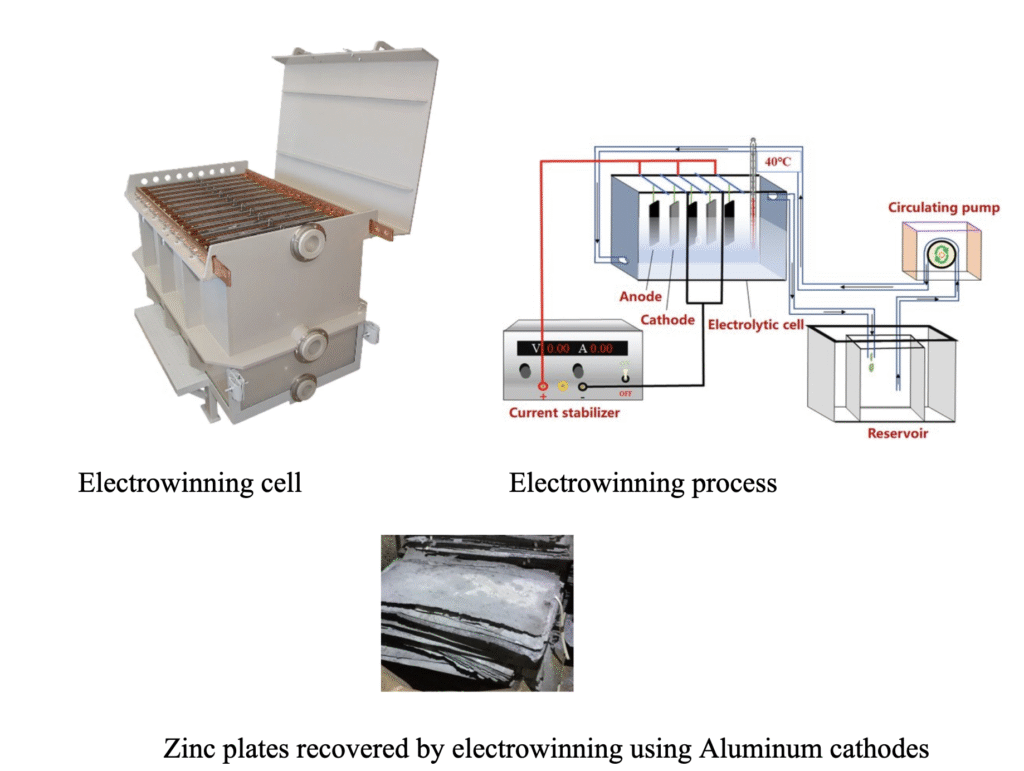
One of the best procedures to recover zinc from zinc sulphate eluate is the Electrolysis Cells (Electrowinning), permits obtain pure 99,999% zinc metal and sulfuric acid practically free of Zn to be used in pickling bath or other usus in regeneration system
7. SPL regeneration in Hot Dip Galvanizi
After Zn+2 extraction the SPL, based in HCl or H2SO4, can be regenerated according to process mentioned in precedents points 3.1 and 4
8. Conclusions
Acid pickling is an essential process for surface treatment in the steel industry. The choice between HCl and H2SO4 depends on operating conditions and regeneration feasibility. While hydrochloric acid pickling benefits from the Ruthner regeneration method, it has limitations concerning other metal contamination, The new ARS DIME is a very competitive and eficient technology. In case of Sulfuric acid pickling offers greater flexibility with its cooling crystallization regeneration, making it highly effective in galvanizing applications where zinc removal is necessary. Advanced techniques like ion-exchange resins further enhance acid recovery, contributing to more sustainable industrial practices.